
Designing Triage Rules That Put Patient Safety First: Smart Intake for Specialty Clinics
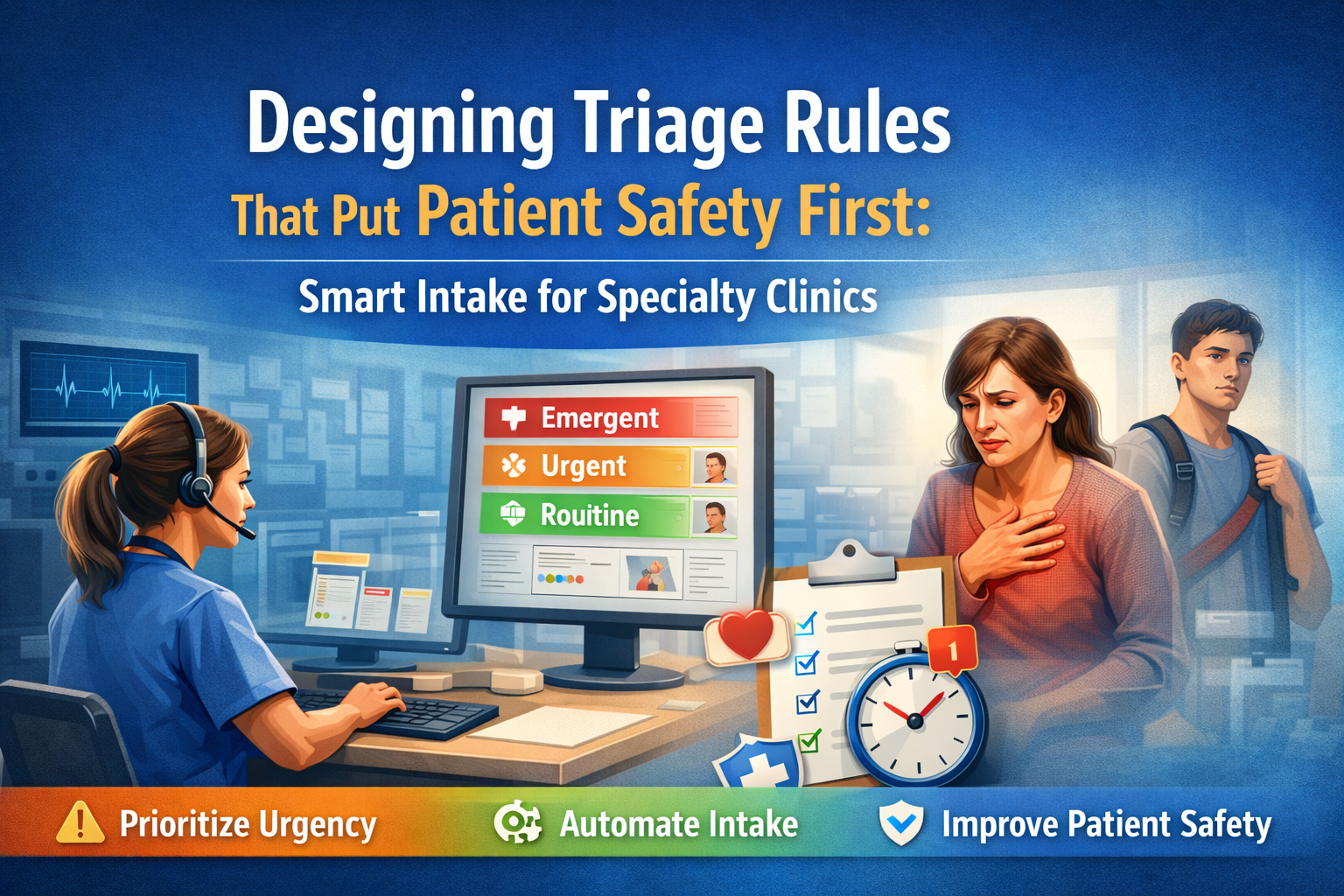
Designing Triage Rules That Put Patient Safety First: Smart Intake for Specialty Clinics
Introduction: Why triage matters
If you’ve ever stood in the middle of a referral inbox—fax tray overflowing, voicemails blinking, portal messages piling up—you know that not every case is created equal. Some patients can safely wait a few weeks; others need to be seen yesterday.
The art of triage is about sorting urgency so that high-risk patients don’t fall through the cracks. It’s not a new concept: the word triage comes from the French trier, meaning to sort. Historically used on battlefields to prioritize wounded soldiers, triage today is part of every emergency department algorithm.
Yet in many specialty clinics, referral intake still feels like a first-come, first-served queue. That creates risk. Studies of mental-health triage systems found that only 54% of triage decisions based on referral information matched the urgency determined after seeing the patient. In 27% of cases, urgency was underestimated. Under- and over-estimation both compromise patient safety.
This post explores how specialty clinics can design triage rules that put patient safety first—without drowning staff in manual work. We’ll cover why triage matters, where current referral processes fall short, and how modern tools like smart triage can transform intake into a patient-safety engine.
Why “first-come, first-served” fails patients
Most specialty clinics receive referrals via fax, email, or portal messages. Staff often pick up cases in the order they arrive. While that seems fair, it ignores clinical urgency.
Let’s illustrate:
* Case A: A middle-aged woman referred for new onset chest pain and dizziness.
* Case B: A teenager referred for a routine sports physical.
If both faxes land at 3 pm on Friday and aren’t reviewed until Monday, Case A waits behind Case B. That delay could lead to an emergency room visit or, worse, an adverse outcome.
Manual triage fails patients because:
* Missing context: Referrals are often a single line (“joint pain, positive ANA”). Without guidelines, staff guess urgency.
* Subjective decisions: Different coordinators prioritise differently. A study of mental-health triage found that nearly half of referrals had inconsistent urgency ratings when assessed by different specialists.
* Delayed follow-up: When triage is done days after receipt, patients drift to other providers or worsen. Nurse-first triage models show why speed matters: connecting patients to a clinician immediately improves safety and avoids unnecessary ER visits.
What makes a great triage system?
Triage isn’t just about speed; it’s about consistency, accuracy, and safety. A modern triage system should:
* Incorporate evidence-based criteria. The Emergency Severity Index and similar algorithms ask whether a patient requires immediate life-saving interventions. For referrals, clinics need specialty-specific rules (e.g., “chest pain within 48 hours,” “new neurological deficit within 72 hours”).
* Surface missing information. High-risk factors (e.g., age, comorbidities) often hide in the referral notes. Automated parsing can extract diagnoses, medications and insurance details and flag absent fields.
* Balance urgency with resources. Over-estimating urgency wastes scarce appointment slots. Under-estimation risks harm. A rule engine can apply priority tiers (e.g., emergent, urgent, routine) and adjust based on clinic capacity.
* Document decisions. Recording why a case was prioritized fosters transparency and helps refine rules over time.
Designing your triage rules: a framework
Here’s a practical framework to create triage rules that protect patients and staff:
1. Define your urgency categories
Start by working with physicians to agree on categories (e.g., emergent, urgent, routine, low acuity). For each subspecialty, define examples: chest pain, syncope, or new neurological deficit should be emergent; stable rheumatoid arthritis can wait two weeks.
2. Map minimum data sets
List the must-have fields before a case can be triaged: patient demographics, diagnosis, duration of symptoms, insurance details, referring provider contact. Without these, your triage may rely on incomplete information, leading to misclassification.
3. Build decision rules
Translate physician guidance into if-then statements. For instance:
* If diagnosis contains “chest pain,” priority = emergent.
* If patient is over 70 and has “abdominal pain,” priority = urgent.
* If referral lacks a diagnosis but includes “routine follow-up,” priority = routine, but send a missing-info request.
Use a rules engine or a simple spreadsheet to start; later you can embed it in software.
4. Automate data extraction and scoring
Manual triage fails when staff must read every fax. Modern intake platforms extract structured data from faxes and emails via OCR. They then apply triage rules automatically, ranking cases in a unified inbox. This means high-risk referrals surface instantly—before human review.
5. Incorporate human oversight
Automation shouldn’t replace clinical judgment. Set thresholds where coordinators or nurses can override the algorithm. For example, any case flagged as emergent triggers an immediate nurse review, echoing the nurse-first triage model that improves patient safety.
6. Revisit and refine
Track how triage decisions correlate with outcomes. If emergent cases turn out to be routine or vice versa, update your rules. Regular reviews improve accuracy and build trust.
Contrarian insight: triage isn’t just for emergencies
It’s tempting to think of triage only in crisis settings. But triage is just as critical in routine specialty care. The universal goal of triage—to prioritize patients while optimizing resources—applies whether you’re in an emergency department or processing dermatology referrals. Without triage, clinics risk harming patients and burning out staff.
Monday-morning checklist: build smarter triage in a week
Need a starting point? Here’s a simple plan you can begin next Monday:
- Audit your current queue. Review the last week’s referrals. How many were emergent, urgent, or routine? Did any wait too long?
- Set up a triage meeting. Bring together physicians, coordinators, and a nurse to define urgency categories and examples. Capture consensus in a shared document.
- Identify missing data. For each referral, list missing fields (insurance, diagnosis). Create a minimum data set and hold incomplete referrals until filled.
- Draft rules. Write simple if-then statements for top conditions. Use a spreadsheet or your intake software’s rule builder.
- Implement a test run. Apply rules to a small sample of new referrals. Compare algorithmic priorities with human judgment.
- Review and adjust. After a week, compare triage decisions to outcomes. Were urgent cases seen promptly? Did anyone slip through? Adjust rules accordingly.
Conclusion: turning triage into a safety engine
When designed thoughtfully, triage transforms referral intake from a first-come, first-served queue into a patient-safety engine. By codifying urgency categories, collecting the right data, and applying rules consistently, clinics can ensure that high-risk patients receive timely care and routine cases don’t clog the schedule.
The goal isn’t just speed; it’s precision—the right patient, at the right time, for the right reason.
Ready to see how IntakeDesk’s smart triage combines automated data extraction, rule-based scoring, and nurse oversight? Explore our documentation to learn how referrals are captured and triaged in a unified workflow. When you’re ready to prioritize patient safety and reduce burnout, book a demo and our team will walk you through it.
Frequently Asked Questions
What is triage in referral intake?
Triage means sorting referrals based on urgency. It originates from the French word trier (“to sort”) and is widely used in emergency care to prioritize patients. In referral intake, triage helps clinics decide which patients need immediate attention and which can wait.
How do incomplete referrals affect triage decisions?
Incomplete referrals lead to guesswork. Research shows that when triage relies only on referral letters, urgency is underestimated in 27% of cases. Collecting required data (diagnosis, symptom severity, insurance) upfront improves triage accuracy.
Do we need new software to implement triage rules?
Not necessarily. You can start with simple spreadsheets or checklists. However, automating data extraction and rule application via referral intake software reduces manual work and ensures consistency.
What role do nurses play in triage?
Nurse-first triage models place clinically trained professionals at the initial point of contact. Nurses provide immediate, evidence-based guidance, improving patient satisfaction and safety. Even with automated triage, nurse oversight catches edge cases and ensures quality.
How often should triage rules be updated?
Regularly. Clinical guidelines evolve, and your clinic’s patient mix may change. Reviewing triage outcomes monthly helps refine rules, preventing both under- and over-estimation of urgency.
Case study: Nurse-first triage in action
It’s one thing to write rules; it’s another to put them into practice. Consider a nurse-first triage model, where the first call a patient makes is answered by a registered nurse rather than an operator. Conduit Health Partners describes how this approach improves patient satisfaction and safety:
* Immediate clinical expertise. Patients speak directly to a nurse who can quickly assess symptoms and make evidence-based decisions. There’s no game of telephone or callback delay.
* Reduced anxiety and frustration. Patients aren’t bounced between departments. They get real-time guidance, which reduces stress and increases trust.
* Fewer unnecessary ER visits. Nurses steer patients to the appropriate level of care, preventing costly emergency room visits when urgent care or an office appointment would suffice.
* Enhanced safety. Prompt clinical assessment helps avoid the deterioration that can occur when patients wait for a callback.
The lesson for specialty clinics: triage isn’t just a back-office workflow. It directly affects patient experiences and outcomes. Embedding nurse or clinician oversight into your intake process—whether via phone or software—can ensure that high-risk patients receive timely care, while routine cases are managed efficiently.
Pitfalls to avoid when designing triage rules
Even the best intentions can backfire if triage rules are poorly implemented. Watch for these common pitfalls:
* Overly rigid rules. If your rules don’t allow for clinical judgment, you risk misclassifying nuanced cases. Allow for overrides and escalation paths.
* Ignored feedback loops. Collect feedback from coordinators and clinicians about cases where the algorithm got it wrong. Incorporate that feedback into rule revisions.
* Hidden bias. Algorithms can inadvertently encode biases—such as prioritizing certain diagnoses or patient demographics. Regularly audit decisions for fairness and equity.
* Lack of training. Staff need to understand how triage categories work and why certain cases are escalated. Without buy-in, rules may be ignored or inconsistently applied.
By anticipating these challenges, clinics can build triage systems that not only protect patients but also adapt to real-world complexity.